- News
- Jan 20, 2026
- 4 min read
Beyond Aero Completes First BYA-1 Electric Business Jet Tests
Testing at speeds of up to 288 kilometers per hour focused on the aircraft’s unique external hydrogen tank configuration.


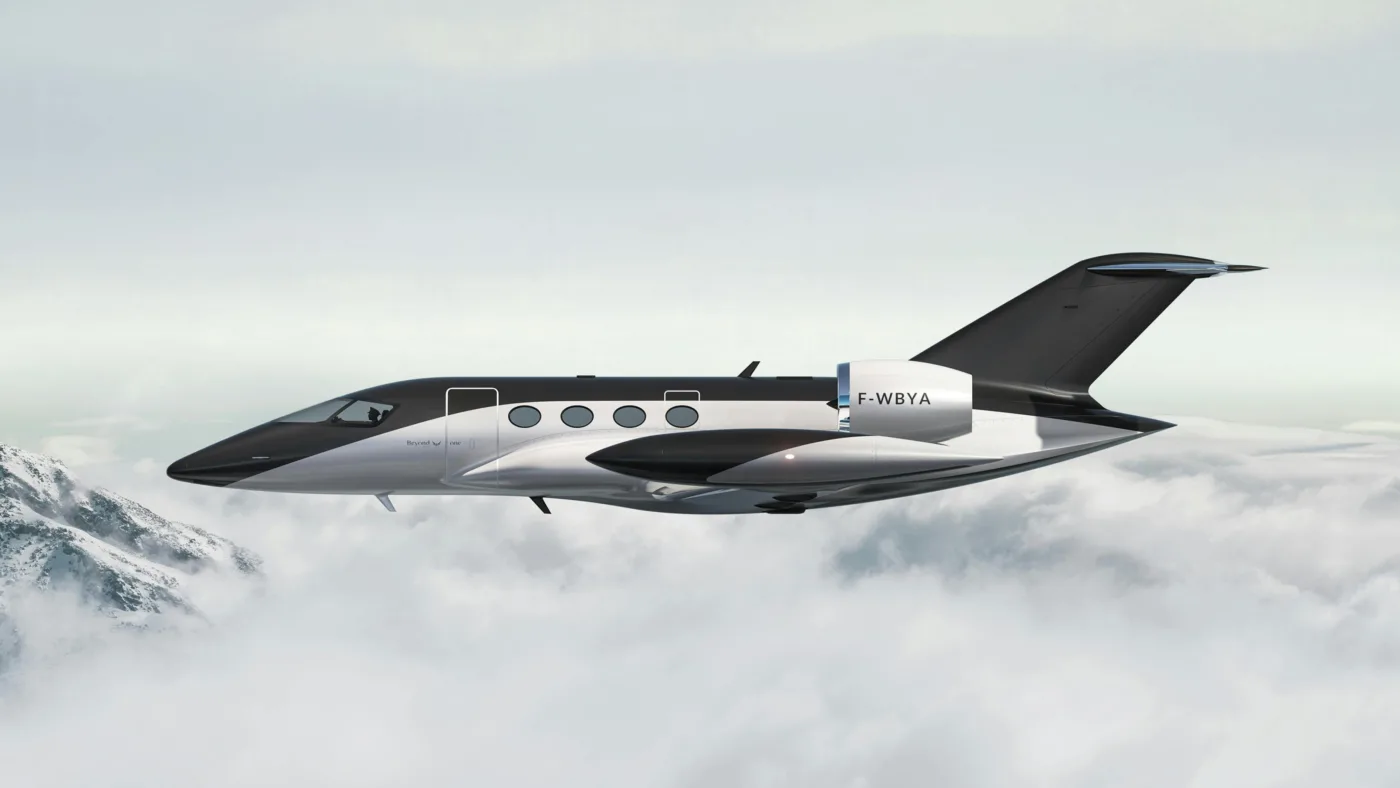
Beyond Aero has completed the first wind-tunnel tests of its BYA-1 hydrogen-electric business jet and moved closer to the end of the preliminary design phase. On January 19, the French startup said that tests using a 1:8-scale model were conducted over five weeks in fall 2025 at the German-Dutch low-speed wind tunnel in Marknesse, the Netherlands.
The Toulouse-based company is developing a product that it positions as the first hydrogen-powered electric business jet, focusing on fuel-cell technology and gaseous hydrogen to carry six passengers up to 1500 kilometers.
The recent wind-tunnel tests build on design improvements, including an increase in fuel-cell power to 2.4 megawatts and wing-mounted gaseous fuel tanks pressurized to 700 bar. In October last year, Beyond Aero said its hydrogen-electric powertrain had also reached Technology Readiness Level 6.
“Placing the fuel tanks outside the fuselage’s main volume makes aerodynamic optimization both necessary and interesting, as it allows us to actively manage these flow interactions rather than constrain them internally, while also addressing hydrogen-specific safety, integration and certification considerations,” Beyond Aero said. The manufacturer reports that the wind-tunnel analysis achieved its objective by validating the main aerodynamic assumptions associated with the hydrogen architecture and confirming that the external hydrogen-powered configuration behaves in a stable, predictable and controllable manner within the specified flight-performance envelope.
The tests also examined performance, stability and controllability across a wide range of configurations. Qualitative stall characteristics—such as onset, controllability and overall behavior—“are consistent with what we expect at this stage of the program,” a company representative confirmed.
Beyond Aero has not yet disclosed plans for completing the next stage of the forthcoming preliminary design review, confirming only that work to “identify sensitive areas and refine trade-offs” will continue to further develop the BVA-1. “As with any aviation program, decisions on full-scale prototypes are tied to progress through these stages,” the company representative concluded. Beyond Aero previously said it planned to put the aircraft into service around 2030.
Beyond Aero has completed the first wind-tunnel tests of its BYA-1 hydrogen-electric business jet and moved closer to the end of the preliminary design phase. On January 19, the French startup said that tests using a 1:8-scale model were conducted over five weeks in fall 2025 at the German-Dutch low-speed wind tunnel in Marknesse, the Netherlands.
The Toulouse-based company is developing a product that it positions as the first hydrogen-powered electric business jet, focusing on fuel-cell technology and gaseous hydrogen to carry six passengers up to 1500 kilometers.
The recent wind-tunnel tests build on design improvements, including an increase in fuel-cell power to 2.4 megawatts and wing-mounted gaseous fuel tanks pressurized to 700 bar. In October last year, Beyond Aero said its hydrogen-electric powertrain had also reached Technology Readiness Level 6.

Sponsored by Jet24 global
“Placing the fuel tanks outside the fuselage’s main volume makes aerodynamic optimization both necessary and interesting, as it allows us to actively manage these flow interactions rather than constrain them internally, while also addressing hydrogen-specific safety, integration and certification considerations,” Beyond Aero said. The manufacturer reports that the wind-tunnel analysis achieved its objective by validating the main aerodynamic assumptions associated with the hydrogen architecture and confirming that the external hydrogen-powered configuration behaves in a stable, predictable and controllable manner within the specified flight-performance envelope.
The tests also examined performance, stability and controllability across a wide range of configurations. Qualitative stall characteristics—such as onset, controllability and overall behavior—“are consistent with what we expect at this stage of the program,” a company representative confirmed.
Beyond Aero has not yet disclosed plans for completing the next stage of the forthcoming preliminary design review, confirming only that work to “identify sensitive areas and refine trade-offs” will continue to further develop the BVA-1. “As with any aviation program, decisions on full-scale prototypes are tied to progress through these stages,” the company representative concluded. Beyond Aero previously said it planned to put the aircraft into service around 2030.
Popular tags: