- News
- Sep 3, 2026
- 7 min read
Beyond Aero and French Airports Prepare for Hydrogen-Powered Flights
Beyond Aero is expanding efforts to create a market for its hydrogen-electric business jet through a partnership with airports in southern France.


Beyond Aero is expanding its efforts to create a market for its hydrogen-electric business jet, now through a partnership with airports in southern France. The Toulouse-based startup and operator Aéroports de la Côte d’Azur announced that they are jointly developing gaseous hydrogen refueling infrastructure. The focus is on airports on the French Riviera, which the partners believe could be among the first to adopt the technology at locations popular with private aviation.
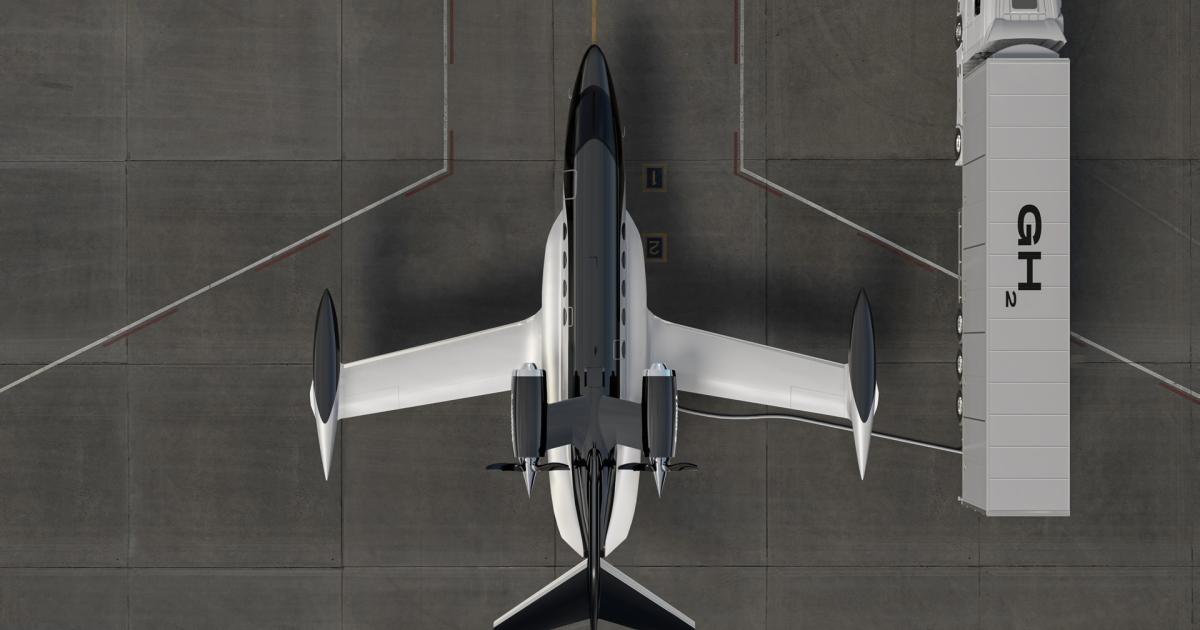
The airports concerned are Nice (LFMN), Cannes-Mandelieu (LFMD), and Golfe de Saint-Tropez (LFTZ). Hydrogen refueling options are being developed for them, including fuel storage and distribution. Two scenarios are under consideration: a fixed refueling station at a dedicated parking stand for hydrogen-powered aircraft and a mobile refueling vehicle.
“Infrastructure readiness must keep pace with the development of the aircraft themselves,” Beyond Aero co-founder and CEO Eloa Guillotin said at a press conference in Nice. “Together with Aéroports de la Côte d’Azur, we are starting from practical scenarios designed for business aviation volumes and technologies available today. This phased approach is essential to ensure safe and viable operations when the first aircraft enter service.”
According to the partners, hydrogen fuel could be produced near the airports and transported across their grounds in a dedicated tube trailer to the refueling station. Locating fuel production nearby would also allow it to be used for other local needs as part of a regional hydrogen ecosystem.
All three French Riviera airports handle significant business aviation traffic. Beyond Aero says Cannes-Mandelieu is most likely to be the first to receive hydrogen refueling equipment.
Design Changes
In March, Beyond Aero completed the preliminary design review for the eight-seat BYA-1 and is now working toward certification under EASA CS-25 rules, with deliveries expected to begin in the early 2030s. The company switched from CS-23 standards to allow for an increase in maximum takeoff weight to 9.6 tonnes (21,164 pounds), primarily to improve performance following the failure of one engine.
Another notable design change announced at the same time was the abandonment of ducted engines in favor of a pair of pusher propfans in the tail section. According to Beyond Aero chief engineer Luis Oliveira, the change in the fuel-cell-based propulsion architecture was prompted by the fact that certifying the ducted configuration would take longer and cost more, although the company does not rule out using the technology on future aircraft.
Guillotin noted that a zero-emission aircraft could attract younger customers who are currently deterred from private aviation by environmental concerns. The company is also promoting the prospect of lower operating costs: it estimates that the BYA-1 will cost no more to operate than popular turboprop aircraft such as the Pilatus PC-12 and Beechcraft King Air.
Greener and Less Expensive
“We chose this market because we see an urgent need to reduce emissions, and we know that business aviation is willing to pay for innovation—as it has already done with solutions such as winglets,” she said. In her view, the industry is under pressure not only from environmental levies, including France’s controversial solidarity tax, but also from the rise in aviation fuel prices observed since the beginning of the war with Iran.
Beyond Aero expects charter and aircraft management companies to account for about half of sales, with the remainder split equally between wealthy private customers and corporate flight departments. In Europe, Guillotin said, business aviation hubs such as London, Paris, and Geneva would be ideal for the BYA-1, which will have a range of 800 nautical miles with six passengers and a cruising speed of 300 knots.
According to Guillotin, who will pay for the necessary hydrogen infrastructure will depend on the specific location and each airport’s business model. On the aircraft itself, the hydrogen is intended to be stored in tanks integrated into the wingtips. Beyond Aero already has infrastructure partnerships with Aéroports de Paris and business aviation services group Luxaviation.
Beyond Aero’s team of 80 engineers is currently working toward the critical design review and the first flight of a full-scale prototype. The company has not disclosed the timeline for either milestone and plans to conduct additional funding rounds to bring the BYA-1 to market.
Beyond Aero is expanding its efforts to create a market for its hydrogen-electric business jet, now through a partnership with airports in southern France. The Toulouse-based startup and operator Aéroports de la Côte d’Azur announced that they are jointly developing gaseous hydrogen refueling infrastructure. The focus is on airports on the French Riviera, which the partners believe could be among the first to adopt the technology at locations popular with private aviation.
The airports concerned are Nice (LFMN), Cannes-Mandelieu (LFMD), and Golfe de Saint-Tropez (LFTZ). Hydrogen refueling options are being developed for them, including fuel storage and distribution. Two scenarios are under consideration: a fixed refueling station at a dedicated parking stand for hydrogen-powered aircraft and a mobile refueling vehicle.
“Infrastructure readiness must keep pace with the development of the aircraft themselves,” Beyond Aero co-founder and CEO Eloa Guillotin said at a press conference in Nice. “Together with Aéroports de la Côte d’Azur, we are starting from practical scenarios designed for business aviation volumes and technologies available today. This phased approach is essential to ensure safe and viable operations when the first aircraft enter service.”

Sponsored by Jet24 global
According to the partners, hydrogen fuel could be produced near the airports and transported across their grounds in a dedicated tube trailer to the refueling station. Locating fuel production nearby would also allow it to be used for other local needs as part of a regional hydrogen ecosystem.
All three French Riviera airports handle significant business aviation traffic. Beyond Aero says Cannes-Mandelieu is most likely to be the first to receive hydrogen refueling equipment.
Design Changes
In March, Beyond Aero completed the preliminary design review for the eight-seat BYA-1 and is now working toward certification under EASA CS-25 rules, with deliveries expected to begin in the early 2030s. The company switched from CS-23 standards to allow for an increase in maximum takeoff weight to 9.6 tonnes (21,164 pounds), primarily to improve performance following the failure of one engine.
Another notable design change announced at the same time was the abandonment of ducted engines in favor of a pair of pusher propfans in the tail section. According to Beyond Aero chief engineer Luis Oliveira, the change in the fuel-cell-based propulsion architecture was prompted by the fact that certifying the ducted configuration would take longer and cost more, although the company does not rule out using the technology on future aircraft.
Guillotin noted that a zero-emission aircraft could attract younger customers who are currently deterred from private aviation by environmental concerns. The company is also promoting the prospect of lower operating costs: it estimates that the BYA-1 will cost no more to operate than popular turboprop aircraft such as the Pilatus PC-12 and Beechcraft King Air.
Greener and Less Expensive
“We chose this market because we see an urgent need to reduce emissions, and we know that business aviation is willing to pay for innovation—as it has already done with solutions such as winglets,” she said. In her view, the industry is under pressure not only from environmental levies, including France’s controversial solidarity tax, but also from the rise in aviation fuel prices observed since the beginning of the war with Iran.
Beyond Aero expects charter and aircraft management companies to account for about half of sales, with the remainder split equally between wealthy private customers and corporate flight departments. In Europe, Guillotin said, business aviation hubs such as London, Paris, and Geneva would be ideal for the BYA-1, which will have a range of 800 nautical miles with six passengers and a cruising speed of 300 knots.
According to Guillotin, who will pay for the necessary hydrogen infrastructure will depend on the specific location and each airport’s business model. On the aircraft itself, the hydrogen is intended to be stored in tanks integrated into the wingtips. Beyond Aero already has infrastructure partnerships with Aéroports de Paris and business aviation services group Luxaviation.
Beyond Aero’s team of 80 engineers is currently working toward the critical design review and the first flight of a full-scale prototype. The company has not disclosed the timeline for either milestone and plans to conduct additional funding rounds to bring the BYA-1 to market.
Popular tags: