- News
- Aug 6, 2026
- 4 min read
Dassault Falcon 10X Entry Into Service Delayed From 2027 to 2029
CEO Éric Trappier attributes the delay to stricter standards governing the development of all-new aircraft.


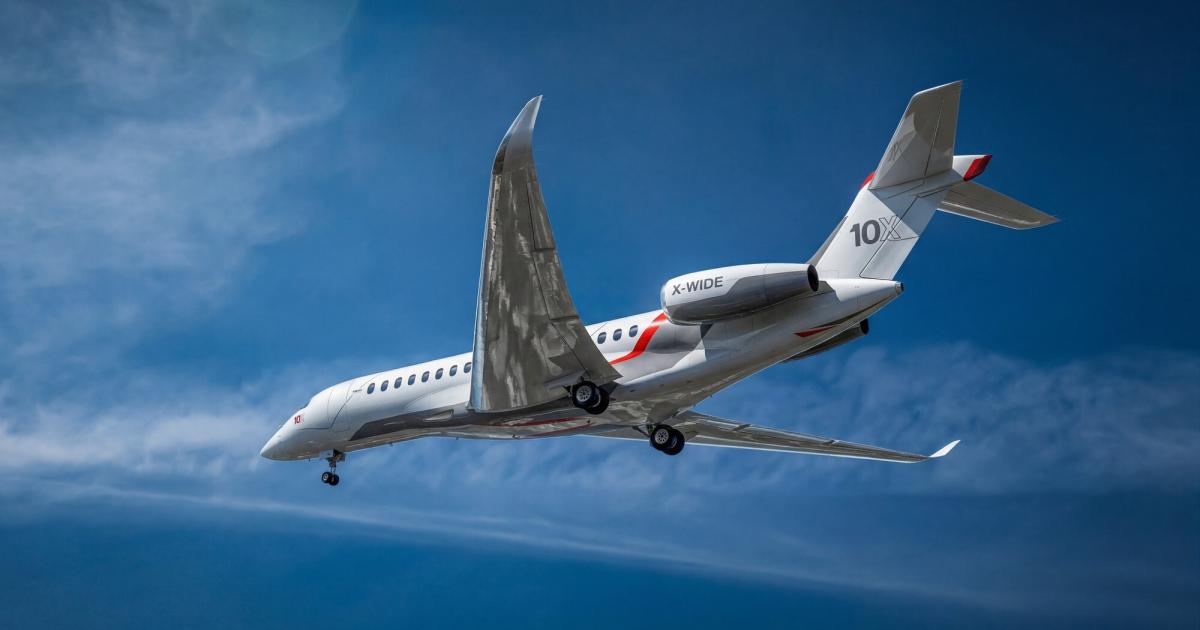
Dassault Aviation has pushed back certification of its flagship Falcon 10X to 2029—two years later than anticipated just last month, when the aircraft made its first flight. At a press conference covering the first-half results, CEO Éric Trappier attributed the delay to stricter regulatory requirements that took effect in 2023 following the Boeing 737 Max crashes.
According to Trappier, certification of an all-new aircraft now takes longer because new rules apply that were not in place when its predecessor, the Falcon 6X, was approved. The company is allowing roughly two and a half years to complete all stages, so the first flight in the certification program is not expected before 2029. Yet only a month ago, immediately after the first flight, Dassault expected to obtain type certification as early as 2027.
The Falcon 10X made its first flight on June 19 at Bordeaux-Mérignac. Test pilots evaluated its handling at 15,000 feet, then retracted the landing gear and movable surfaces, climbed to 40,000 feet, and accelerated the aircraft to Mach 0.82. The test program is now expanding: the second prototype is nearly complete at the Mérignac plant, while the third, with a fully equipped cabin, will be used to test interior systems and comfort. Airfield surfaces are being repaired at the flight-test center in Istres—the Falcon 10X, Trappier acknowledged, is heavier than previous models.
Trappier expressed confidence that the main engineering work has already been completed, although much certification work still lies ahead. He also noted that Dassault remains the only manufacturer to have flown an all-new aircraft of this size in 2026. However, the company’s chief gave no firm assurances on the schedule, promising to return to the issue when there is greater clarity.
The Falcon 10X is powered by two Rolls-Royce Pearl 10X engines, each producing more than 18,000 pounds of thrust, and features NeXus avionics developed jointly with Honeywell. The spacious-cabin, ultra-long-range business jet promises a range of 7,500 nautical miles and a maximum speed of Mach 0.925.
Dassault Aviation has pushed back certification of its flagship Falcon 10X to 2029—two years later than anticipated just last month, when the aircraft made its first flight. At a press conference covering the first-half results, CEO Éric Trappier attributed the delay to stricter regulatory requirements that took effect in 2023 following the Boeing 737 Max crashes.
According to Trappier, certification of an all-new aircraft now takes longer because new rules apply that were not in place when its predecessor, the Falcon 6X, was approved. The company is allowing roughly two and a half years to complete all stages, so the first flight in the certification program is not expected before 2029. Yet only a month ago, immediately after the first flight, Dassault expected to obtain type certification as early as 2027.
The Falcon 10X made its first flight on June 19 at Bordeaux-Mérignac. Test pilots evaluated its handling at 15,000 feet, then retracted the landing gear and movable surfaces, climbed to 40,000 feet, and accelerated the aircraft to Mach 0.82. The test program is now expanding: the second prototype is nearly complete at the Mérignac plant, while the third, with a fully equipped cabin, will be used to test interior systems and comfort. Airfield surfaces are being repaired at the flight-test center in Istres—the Falcon 10X, Trappier acknowledged, is heavier than previous models.
Sponsored by Jet24 global
Trappier expressed confidence that the main engineering work has already been completed, although much certification work still lies ahead. He also noted that Dassault remains the only manufacturer to have flown an all-new aircraft of this size in 2026. However, the company’s chief gave no firm assurances on the schedule, promising to return to the issue when there is greater clarity.
The Falcon 10X is powered by two Rolls-Royce Pearl 10X engines, each producing more than 18,000 pounds of thrust, and features NeXus avionics developed jointly with Honeywell. The spacious-cabin, ultra-long-range business jet promises a range of 7,500 nautical miles and a maximum speed of Mach 0.925.
Popular tags: